Tuesday, February 7, 2012

What impact did "Sinners in the Hands of an Angry God" have on the people?

During the eighteenth century, a series of revival moments swept across the colonial Americas, known as the First Great Awakening. Edwards' "Sinners in the Hands of an Angry God" was a big guide into this movement. It was characterized as the First Great Awakening due to its impact and the emotional reactions portrayed by the participants. People wept and even fainted in response to these powerful messages and/or sermons. Many people were hesitant to consider foreign religions, but these were hard to ignore. 

The Half-Way Covenant brought upon Edwards' beliefs and reason to preach this sermon. He thought people were becoming too lenient in their actions and too focused on material things rather than religion, which made him furious. People were becoming accustomed to attending church at their own convenience instead of what was wanted by God himself. This is why he wrote "Sinners in the Hands of an Angry God", to open the eyes of the people and snap them back into reality. In this sermon, he emphasized that Hell was a real place and that if they continued in their ways, God would send them straight there. Even though he didn't spend much time describing Hell to the people, he made sure they were aware it existed and it would be an unbearable misery for eternity.


He only hoped that the imagery depicted in this sermon would make them realize where they were headed if they continued without Christ. He explains that it is nothing but the mere hand of God keeping them from Hell, and it is up to us to rectify our sins before it is too late. Edwards' sermon was so powerful that people were proclaiming the name of Jesus, moaning and crying for help before it was finished. His tongue was compared to a sharp two-edged sword to his viewers. His words must have caused unbearable pain giving these reactions. People all over repented and were saved during and after this sermon's deliverance. 


As you can tell from the excerpt above, his tone is what most likely shocked people. He says that people in this very congregation will suffer from misery and asks how it's possible for them to rest knowing this. These are pretty strong statements, and he delivers them in such a monotone, calm, structured manner. He hardly gestured at all in this sermon, and he didn't force his beliefs on anyone with scorn or anger. He simply remained calm and used his intellect to enlighten people of the truth, and people noticed that. He didn't create horrific visions of torture in order to bring despair, their conscience did that for them. The intense feelings brought upon them through this sermon is what struck them. 
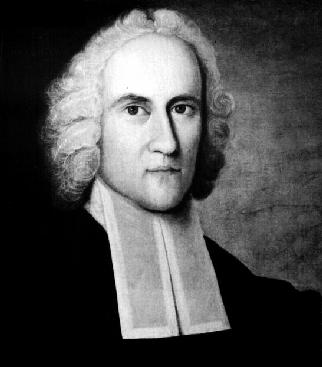

Above is a picture of Jonathan Edwards, the man who delivered this sermon and a man remembered for making such a powerful impact on numerous people during this time and even today. Some people did criticize his sermon, probably because they were scared of the truth, and some believed he was very forward and condemning. Aside from the few that opposed it, most were awakened. It was so powerful that Christians still teach and practice from it today. 


Works Cited:

Tuesday, January 31, 2012

What Is the Puritan Religion All About?

   Religion happened to be one of the most important factors in the Puritan way of life. The Puritans believed they were chosen by God himself for a specific purpose. They lived every day fearing God, knowing He is in control of everything. All were expected to attend group meetings, what we would call church, every Sabbath day. No exceptions or excuses were valid against this specific belief. If they did miss church, they were required to pay a fine. Performing labor on the Sabbath day was also frowned upon and prohibited. Reading the Bible was a requirement, and all who did not were considered to be worshipping the devil.

   Religion wasn’t an option during this time like it is today. No one had a choice of whether or not they wanted to attend church, read their Bible, or perform good works. They also didn’t like for music to be played in the church. Music would indicate a distraction or sense of entertainment, which wouldn’t be acceptable. Their meetings were very structured and very serious. Deacons would poke misbehaving children with “staffs” to immediately correct their behavior, as depicted in this picture.


   This picture shows the Puritan church. They worked in an orderly fashion. Everything was plain and structured, with little focus on ornamental things. Decorations were considered to be a distraction from the faith. They believed that worship should be simple but strict.


   The Puritans believed that every sin had a direct punishment and it’s own consequence. Today, Christians believe the wages of all sin is death. Instead of leaving God in control, they believed that appointed governors were to reward virtue and punish wrongdoers. Some believed in demonic forces and in some allegations of witchcraft. Their Biblical interpretations are said to have been shared with Protestants. They believed in the Christ as Christians do, but with some alteration of ways. Like Catholicism, they emphasized good works to sustain their salvation.

   This video shows how the Puritans believed in offering and salvation, but also expectations when dealing with church. The girl may not be ready for salvation, but she will still be held accountable for following the rule of society, attending church.


   Many of the Puritans believed that the English Reformation wasn’t taken far enough, and that they should have pushed “purity” of worship and doctrine much further. The Puritans who agreed separated themselves into groups, while others remained non-separating Puritans. Those who separated themselves are known as Separatists. Separated or not, Puritans were motivated and determined to make an impact in their generation. If they achieved this, then their goal was accomplished.

   They walked through life with their own personal faith. It was very important for them to pass this faith on to their children and grandchildren. This greatly explains Anne Bradstreet’s purpose behind the letter to her children. She made it clear that her overall goal was to declare the glory of God. Over the years the Puritan way has, for the most part, been neglected; however, few still follow this way of life in some areas today.


Works Cited:
fervis.tripod.com
endtimepilgrim.org/puritans.htm
en.wikipedia.org/wiki/Puritan
www.history.com/topics/puritanism

Monday, January 23, 2012

Who were the REAL "savages"?


     The "savages" referenced in John Smith's writings are the Native Americans. The Europeans didn't find anything wrong with this belittling title. Referring to the Native Americans as "savages" was just a racist comment that would actually help justify the Europeans with the taking of their territory and resources. It was very dehumanizing towards the Natives, and eliminated any idea of worth or feelings.
     Some may admire the Indian way of life, but the Europeans showed little sympathy towards it. They referred to them as "savages" for many reasons such as: their lack of knowledge towards money and property, their outer appearance and behavior, and their less modest cultural background. The Europeans were very cultural prejudice people. The Native Americans were judged for simply protecting themselves and their land the only way they knew how.
     Not only did Native Americans use stone and animal parts to carve tools during this time, but some say they would cut out the heart of animals for food. They were nomads and had no sense of social organization amongst them. Tribal mentality was the only thing they were accustomed to. Their diverse means of religion seemed very confusing to the Europeans; because they didn't understand it, they rejected it.
     Because of the Europeans, many people today have the wrong idea about the Native Americans. Even books and films portray false facts. Most of them focus on the numerous stereotypes that society believes today. For example, the Disney movie, Peter Pan, contains the line “You are our Great White Father”. This represents that Native Americans are subservient to whites, which is not at all true. This movie also shows a chanting scene where the Indians are depicted as somewhat obnoxious, carefree, and wild. We wouldn't have these assumptions and stereotypes if it weren't for the Europeans.


     Many assume that the Native Americans were brutal scalpers out to kill anyone that crossed their path. This picture is an example of modern fiction that shows the “savage” side of a Native American. It was intended to depict their tragic side, the one in which they express resentment towards the white race. Could you blame them?


     The Native Americans can be defended to an extent. They could possibly be described as more civilized than the white men. Everything they did had a reason and a purpose. They were forced to make a life given an insufficient amount of resources, ones they had to accumulate on their own. The most important thing to the Native Americans was their family and their land. Whatever they could do to protect those two things, they would accomplish it. The Native Americans and Europeans definitely came from two different backgrounds and two different ways of life; however, this doesn't make the Natives any less important.


     The Europeans may have referenced the Native Americans as “savages”, but they were the real savages. There isn't anything sane about people from a completely different country invading someone else's land, taking over, and killing many of their kind. That portrays more of a scandalistic view than anything else.

Works Cited
The Norton Anthology, American Literature, Vol A

Wednesday, January 18, 2012

Introduction Blog

My name is Morgan Goodwin. I'm a sophomore here at JSU, majoring in Pre-Health Biology. I graduated from Oxford High School, not to far from the Jacksonville campus. I'm a very energetic person and have great passion towards every single sport, literally. I have played basketball, softball, and volleyball in school, and many others for recreational purposes. Reading has never been something I've thoroughly enjoyed, but I surprisingly really liked Lit 202, so I'm looking forward to this course and what it has to offer.